The ecosystem of the blue economy in the Canary Islands agrees that, to definitively promote this sector, more coordination is needed, financing is protected and its impact on the archipelago is quantified.
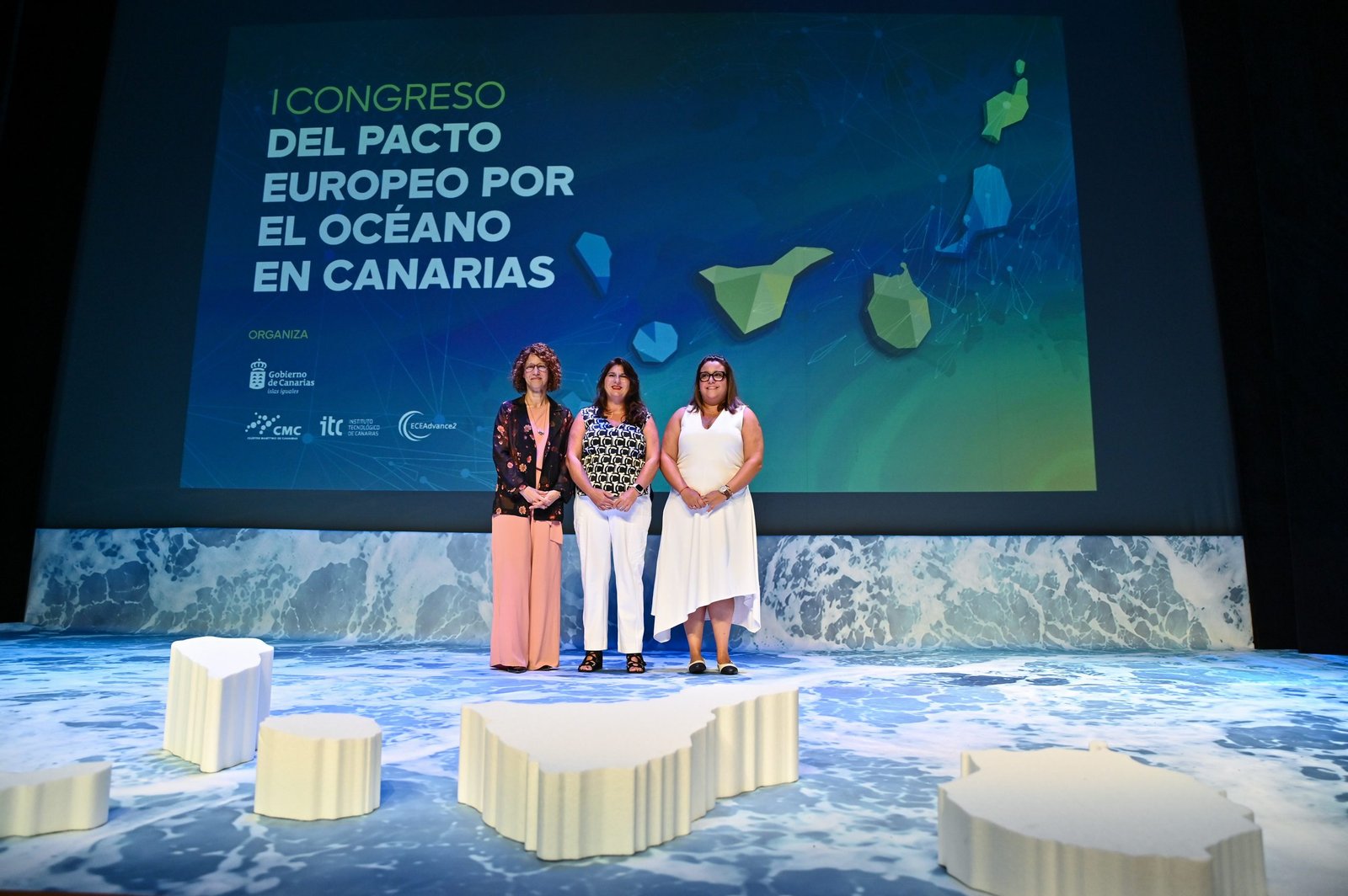
During the congress it became clear that the Canary Islands have companies, knowledge, infrastructure and scientific-technological capacity to continue investing in the ocean as a source of economic diversification.
Las Palmas de Gran Canaria, September 25, 2026.- Julieta Schallenberg, Deputy Minister of Ecological Transition, Fight against Climate Change and Energy of the Government of the Canary Islands, closed today the first Canary Islands congress of the Oceans Pact with a clear conclusion: a "real blue economy for the Canary Islands will only be possible if it combines more coordination, protection of biodiversity and economic development; if something can be clear to us today, it is that there is a lot to do and I believe that this is the meeting point that in the future can allow us to continue walking."
He recalled that the archipelago is one of the 36 “biodiversity hotspots” in the world protected by Natura 2000 and that to achieve a true impact and the challenges posed by the European Pact, “we are all necessary; the public inter-administrative part has to be coordinated, but we also have to go hand in hand with the public-private initiative.” “We have many strategies, but those strategies have to talk to each other,” he said.
Schallenberg reviewed the major themes of this first meeting – biotechnology, water desalination, aquaculture, fishing –, looked at Madeira and the Azores as an international experience and raised other areas of the blue economy as upcoming challenges: “the fight against climate change and the role that the oceans are called to play in the absorption of CO2 is an enormous field still to be explored.”
The CEO of the Canary Islands Technological Institute, Guayarmina Peña, highlighted the need to maintain meeting spaces such as this I Congress of the European Pact for the Ocean in the Canary Islands, recalling that "public-private collaboration has an essential role; we need scientific and technological knowledge to find its position in companies, that companies can transfer their needs to research centers and that the administrations create the conditions to facilitate the development of new projects."
He also highlighted that “the Canary Islands have the companies, the knowledge, the infrastructure and the scientific-technological capacity” to develop their commitment to the blue economy, and that they must “take advantage of the framework opened by the European Pact for the Ocean as an island and outermost territory”, since “the sea is a direct part of our economy, our way of life and our territory”. “We are going to continue working together to take advantage of these opportunities responsibly and turn them into development and innovation for and from the Canary Islands,” he stated.
Ecosystem commitment
The manager of the Canary Islands Maritime Cluster, Elba Bueno, assured that the congress has been “a declaration of intentions” in the sense of following the path set by the motto of the World Maritime Day celebrated on September 24, 'From policy to practice: promoting maritime excellence'.
At the closing of the event, Bueno made a summary of the contributions that emerged from each of the presentations: from the specialist in Circular and Regenerative Economy Manuel Maqueda highlighted that “it is not enough to be sustainable, but we must recognize the economic value of everything that nature gives us”; From the debate on the criticality of the submarine cable, the conclusion is that “The Canary Islands have a strategic position, great industrial experience and interesting fields of development, but they must identify and plan risk management”; while the dual technologies table in the maritime sector leaves as duties "strengthening the positioning of the Canary Islands in this niche with a regulatory process that accompanies companies, improving the ecosystem, strengthening specialized talent, facilitating financing and streamlining administrative management."
The head of the Tourism Unit in the General Directorate of Mobility and Transport (DG MOVE) of the European Commission, Elisabeth Kotthaus, revealed that the future European strategy on sustainable tourism proposes a more balanced management of coastal and island destinations and favoring local communities and companies. Subsequently, the maritime transport decarbonization table confirmed that the Canary Islands “also has a strategic position in this field and with unique conditions to maintain its competitiveness and move towards the progressive incorporation of sustainable fuels”, but also made it clear that the transition to it will be a long process.
The speakers who discussed living resources in the Canary Islands were convinced that the islands have the potential to develop a blue economy based on the sustainable use of these resources. In this context, Bueno assured that "research and knowledge opens new opportunities, but the challenge is to transfer these advances to the market, overcoming the obstacle of the slowness of administrative procedures."
Regarding test benches, the congress concluded that the archipelago has a prominent position in the development of the prototype thanks to infrastructure for technological testing, although the manager of the Maritime Cluster pointed out the need to accelerate the technological journey and strengthen collaboration between administrations, research centers, universities and companies.
In the field of renewable energy, it was once again revealed that “energy sovereignty and autonomy is crucial in island territories and in the face of geopolitical crisis contexts such as the one we are currently experiencing, the Canary Islands have taken important steps, but it is vital that Spain launches an auction that definitively promotes the development of offshore wind power for commercial use.” And, as for coastal tourism, "it is hidden from no one that the future is conditioned by the conservation of the coastline, the quality of our waters, the control of discharges...".
On the other hand, the head of the Maritime Economy Team of the Joint Research Center (JRC) of the European Commission, Jordi Guillén, also showed that without ecological, economic and social sustainability "we will not be competitive in the long term, and if we are not competitive, we will not be able to guarantee sustainability either."
To conclude the congress, the debate on the impact of the blue economy left on the table one of its main shortcomings: the lack of homogeneous data that allows us to know its real dimension. Under the premise that what is not measured cannot be valued, the need to agree on both the real definition of the blue economy and the activities that are part of this field and harmonize indicators and methodologies was highlighted. “Having rigorous information will also make it possible to identify risks, quantify their economic value and plan for the long term,” concluded Elba Bueno.