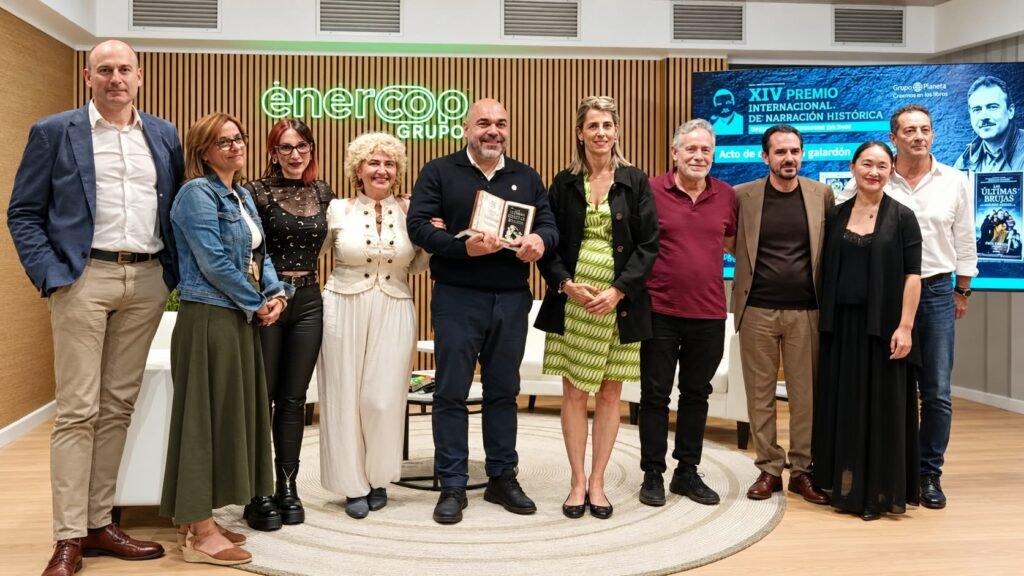
The Gomero writer and popularizer Carlos Jesús Pérez Simancas collected in Crevillent the 14th Juan Antonio Cebrián Villa de Crevillent International Prize for Historical Dissemination, awarded to his work Troy and the Wrath of Achilles. The collapse of the Bronze Age and the birth of the West. The ceremony brought together institutional representatives, writers and disseminators around History and the memory of the person who made it an extraordinary radio adventure.
The ceremony was attended by the mayor-president of Crevillent, Lourdes Aznar Miralles, and the first deputy mayor, Antonio José Candel Rives, who participated in a night dedicated to books, dissemination and the memory of Juan Antonio Cebrián.
The jury recognized the winning work for its originality, literary quality and research work. Pérez Simancas returns to The Iliad to search, behind Achilles, Hector, Helen, Agamemnon or Priam, for the traces of a real Mediterranean, marked by rivalries between powers, trade routes and the great crisis that transformed the world at the end of the Bronze Age.
The award also had a second name, that of Raúl Ferrero Martínez, finalist with The Last Witches. The Valencian sorceresses against the Inquisition. A health problem in his family environment prevented him from traveling to Crevillent, although he was present through a video projected during the event. Her research recovers, from inquisitorial documentation, the stories of Valencian women accused of witchcraft. The work will also be published by Almuzara, something that has only happened for the second time in the history of the contest.
After the delivery came one of the central moments of the night. Silvia Casasola moderated a gathering in which Jesús Callejo, Laia San José Beltrán, José María Aznar Miralles and Pérez Simancas himself participated.
Callejo led the conversation towards myths and their ability to survive the passage of time. Troy served as an example of that persistence: three thousand years later we continue to return to its walls to ask ourselves where History ends and where the legend begins.
The writer Laia San José Beltrán focused on the women of Greek mythology and The Iliad. Helen, Hecuba, Andromache and Cassandra allowed us to look at the epic from the other side of the war: that of those who wait, lose and survive the decisions of heroes and kings.
José María Aznar Miralles, from Grupo Enercoop, addressed the cultural influence of those stories and their permanence in the West. Troy disappeared as a political reality, but it survived in Rome, in literature, in art and in a cultural tradition that still recognizes its characters.
Pérez Simancas completed the conversation from History, placing the Homeric story in the context of the crisis that transformed the eastern Mediterranean around 1200 BC. From this border between memory and event arises one of the central questions of Troy and the Wrath of Achilles: how much History can survive within a myth after three thousand years.
A native of Playa de Santiago, in La Gomera, Carlos Jesús Pérez Simancas is a writer, historical disseminator and official tourism guide of the Government of the Canary Islands. He is the author of Mitomancia and Los Pueblos del Mar and is currently a member of the Tertulia Amigos del 25 de Julio, dedicated to the study and dissemination of the history and heritage of the Canary Islands.
The Juan Antonio Cebrián International Prize is endowed with 4,000 euros in copyright and includes the publication of the winning work by Almuzara. The contest is organized by the Crevillent City Council and the Juan Antonio Cebrián Cultural Association, with the collaboration of Grupo Enercoop.
Perhaps that is why the night found its best tribute without the need for great solemnities. Juan Antonio Cebrián was remembered doing what he did for so many years: telling stories. They talked about Troy and the Valencian sorceresses, about Homer and the women of The Iliad, about myths, archeology and memory.
For the first time, a Canarian author added his name to the winners of the Juan Antonio Cebrián International Historical Dissemination Award. From Playa de Santiago to Crevillent it is a long journey. From La Gomera to Troy, an even bigger one. Books have that strange virtue: bringing together places, times and men who seemed condemned to never meet.