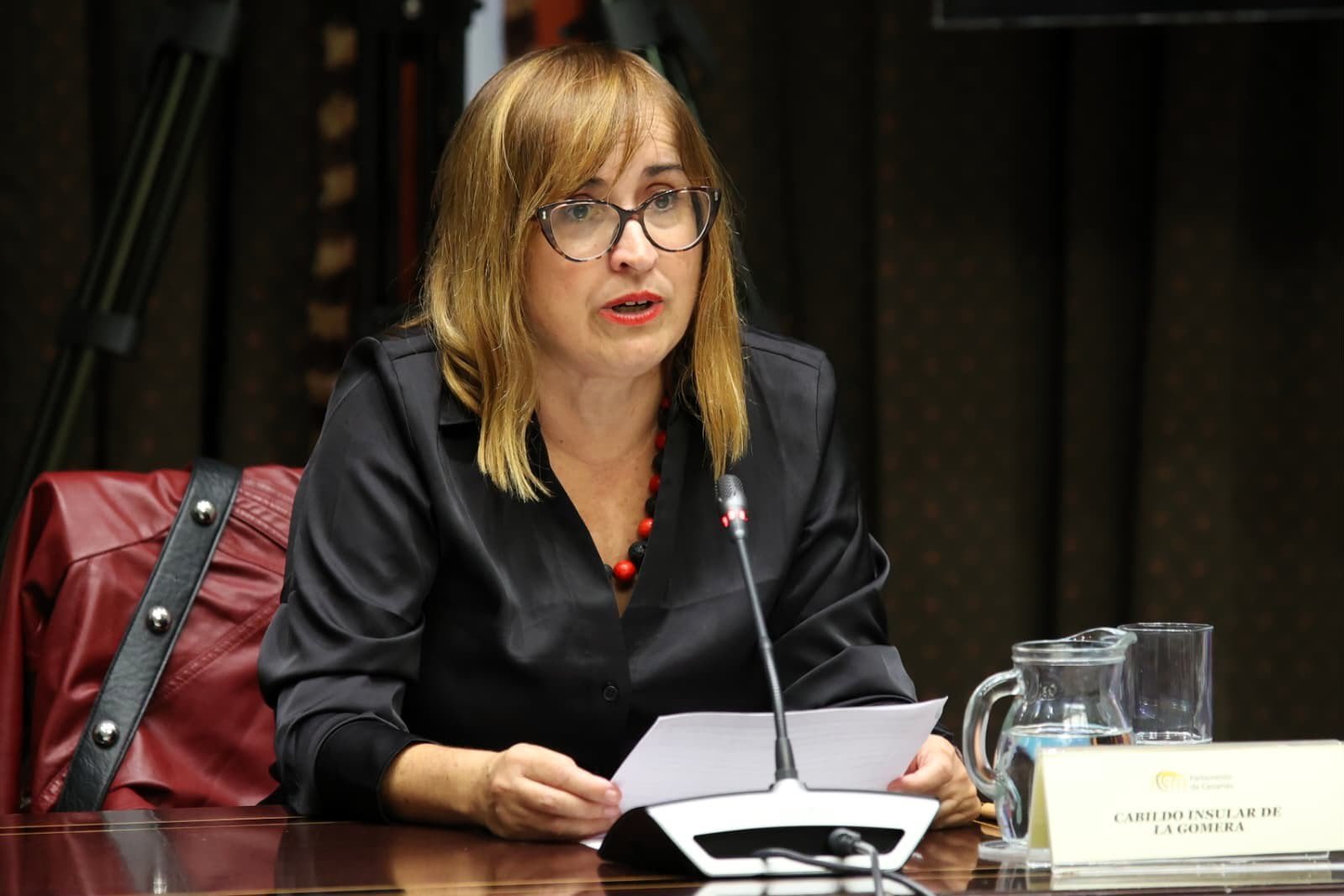
Máñez presents the Ministry's roadmap to comply with the Social and Economic Reactivation Pact with 4 axes in terms of employment: special employment plans, support and advice, training and administrative modernization
The Government of the Canary Islands will allocate more than 50 million euros until the end of the year to combat unemployment. This was announced by the Minister of Economy, Knowledge and Employment, Elena Máñez, during her appearance before the Plenary Session of Parliament, at her own request, to report on the current employment situation, the objectives and actions to be developed in this matter by her department, an intervention in which she gave an account of the Ministry's roadmap to comply with the Pact for the Social and Economic Reactivation of the Canary Islands, in terms of employment, based on four axes: special employment plans; support and advice; training and flexibility and administrative flexibility and modernization.
Regarding employment plans, Máñez explained that there will be a part of the funds from the Canary Islands Comprehensive Employment Plan (PIEC) and others from the Canary Islands Employment Service (SCE) “which we have redirected, in record time, to make them available for the new situation generated by COVID-19.” Among the main measures that will be activated, and that will be included in the future Plan for the Social and Economic Reactivation of the Canary Islands, is a tourist employment plan in the municipalities with the greatest affluence most affected by the pandemic, endowed with 10 million euros and focused on activities such as the beautification of tourist areas, surveillance and raising public awareness about health measures. In addition, another 10 million euros will be allocated for COVID-19 employment plans, aimed at unemployed people affected by the health crisis, mainly with family responsibilities and unemployed single-parent families.
Likewise, another 5 million will be allocated for an ecological transition plan that will be executed through the councils, in line with the 2030 Agenda and that will be linked to the new blue and circular economies. Finally, the counselor reported another measure, endowed with 20 million, to reissue the social employment plans with the municipalities of the Canary Islands, in coordination with the Canarian Federation of Municipalities (Fecam), to serve the most vulnerable families and long-term unemployed people.
As the counselor pointed out, the search for “shared and consensual solutions” to this crisis has led the Ministry to maintain permanent contacts with all the agents involved, especially the union and business organizations, with four calls from the General Employment Council; the reactivation of the Council to Support Entrepreneurship, Self-Employment and Canary Island SMEs and more than 50 meetings with administrations and organizations “to form a common front against the social and economic consequences of the COVID-19 crisis.”
Support and advice for SMEs and self-employed people
Elena Máñez announced that, within the framework of the Council to Support Entrepreneurship, Self-Employment and Canarian SMEs, two working groups have been established that will be responsible, respectively, for addressing the preparation of the Entrepreneurship Support Plan and analyzing an improvement to the Canary Islands Entrepreneurship Law. As the counselor pointed out, the Entrepreneurship Plan “must be approved by this Parliament” and “has to respond to the needs of SMEs and the self-employed in the coming years, in which the effects of this crisis will still be felt.”
However, until this Plan is approved, the counselor pointed out that the support measures for SMEs and self-employed people will be reinforced with two new cabinets, one for analysis and advice on ERTE, endowed with 190,000 euros, and a support unit in the Canarian Employment Service for advice to self-employed people and SMEs, endowed with 120,000 euros. Both are added to the Comprehensive Business Services of the SCE, endowed with 1,900,000 euros, and to the assistance and advice service for companies of the Cide Network, endowed with 2,521,122 euros for the period 2020-2022. On the other hand, he insisted on the importance of adapting special training plans to the island and regional reality, in coordination with local corporations, economic and social agents, taking advantage of the new opportunities offered by emerging sectors linked to the blue and circular economies.
Máñez also referred to a new measure specifically aimed at workers affected by an ERTE caused by COVID-19, for an initial amount of 500,000 euros, expandable, to encourage the improvement of their contractual conditions once the file is finalized.
Furthermore, the commitments of the Pact highlight the fight against the underground economy. Thus, for the first time, the Canarian Employment Service will launch a specific measure, endowed with 100,000 euros that can be expanded, to promote the hiring of unemployed people to provide domestic services, which will allow irregular employment to emerge in this sector, a situation that especially affects women.
Another of the pillars of the Pact is the modernization and flexibility of the administration. For this reason, the SCE is currently working on the design of a technology-based modernization plan to, said Máñez, “advance in the processes of demand management and virtualization of services, incorporating the potential of new technologies to citizen service services” and which will have the objectives of offering value-added services to citizens or collaborating entities; improve management support systems to incorporate simplification measures in processing and improve technological infrastructure and guarantee information security.